
Diastasis Recti Repair in Surat: Tummy Gap After Pregnancy Explained
Dr. Vikram Lotwala
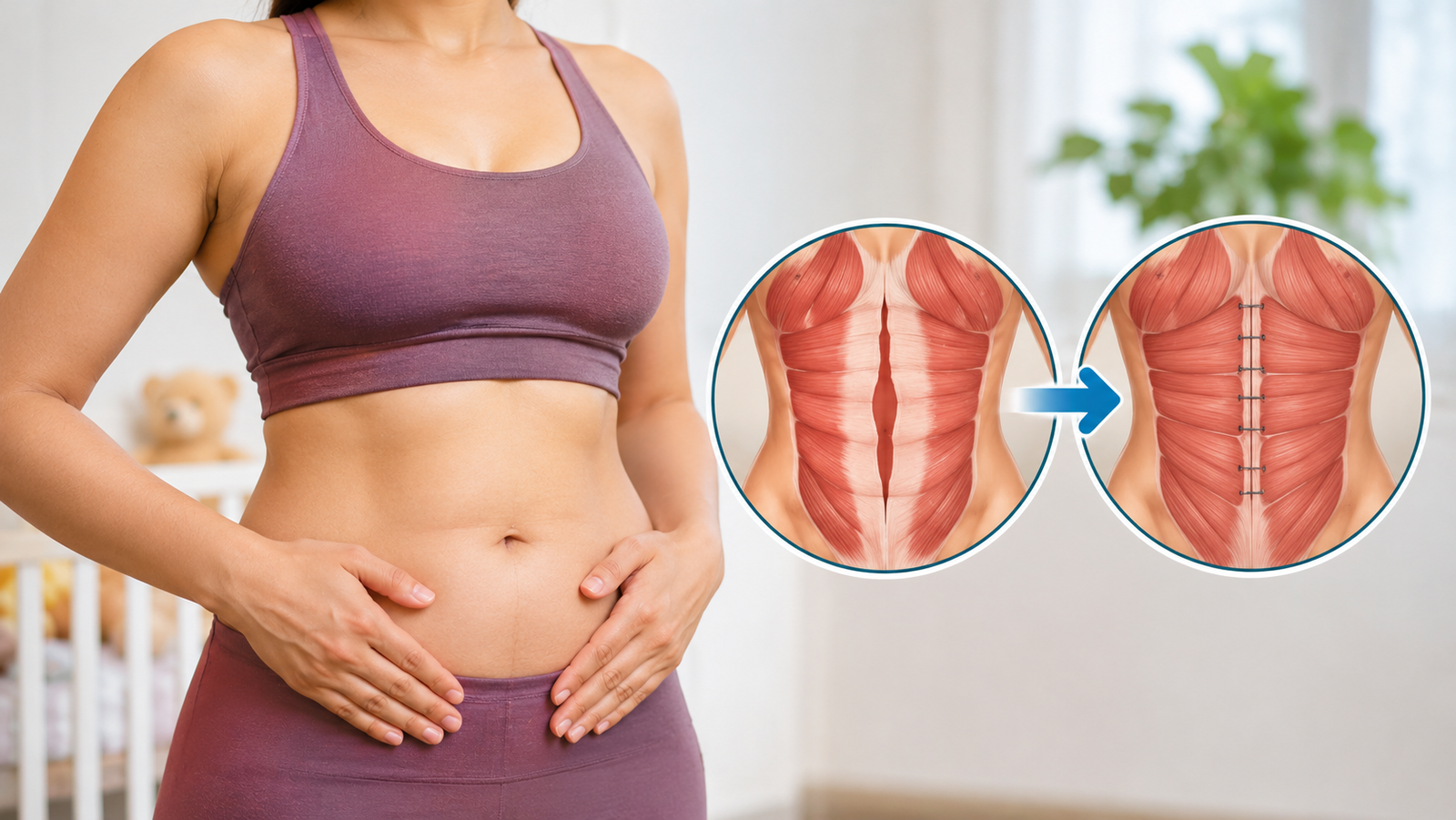
Diastasis recti is a separation between the two front abdominal muscles, often developing after pregnancy. Physiotherapy may improve abdominal function, while persistent symptomatic separation, particularly with an umbilical or ventral hernia, may require surgical assessment. Selected patients may benefit from procedures such as eTEP-RS hernia repair.
Many women notice that their abdomen continues to protrude even after losing pregnancy-related weight. This may result from stretching and widening of the connective tissue between the abdominal muscles rather than excess body fat alone.
Patients considering diastasis recti repair in Surat should understand that not every abdominal muscle separation requires surgery. Treatment depends on symptoms, abdominal function, associated hernias and future pregnancy plans.
Dr. Vikram Lotwala at Wings Hospital, Adajan, can assess abdominal wall concerns and determine whether further investigations or surgical treatment are appropriate.
What Diastasis Recti Is
Diastasis recti, also called rectus diastasis, occurs when the connective tissue known as the linea alba stretches and widens between the left and right rectus abdominis muscles.
These muscles help support the abdomen, maintain posture and assist with everyday movements.
During pregnancy, the growing uterus places pressure on the abdominal wall. Hormonal changes and tissue stretching can contribute to separation of the abdominal muscles.
Although commonly associated with pregnancy, diastasis recti can also affect men and individuals who have experienced significant weight changes.
Common Causes of Diastasis Recti
Factors associated with abdominal muscle separation include:
-
Pregnancy and childbirth.
-
Multiple pregnancies.
-
Significant weight fluctuations.
-
Increased abdominal pressure.
-
Obesity.
-
Changes in connective tissue strength.
What Are the Symptoms?
Some people experience visible abdominal changes without significant discomfort, while others notice reduced core stability.
Common symptoms may include:
-
A persistent abdominal bulge.
-
Doming along the abdominal midline during movement.
-
Difficulty engaging the abdominal muscles.
-
Reduced core strength.
-
Discomfort during certain physical activities.
-
Changes in abdominal appearance after pregnancy.
Patients seeking diastasis recti repair in Surat may also have an associated abdominal wall hernia that requires separate assessment.
Diastasis recti alone does not create the same type of abdominal wall defect as a hernia. However, both conditions can occur together.
Self-Check for a Tummy Gap
A gentle home self-check may help identify possible abdominal muscle separation. However, it cannot confirm the diagnosis, accurately determine severity or exclude an associated hernia.
How to Check for Abdominal Muscle Separation
If you have recovered sufficiently from childbirth and have no restrictions on abdominal movement, you may try the following:
-
Lie comfortably on your back with your knees bent.
-
Keep your feet flat on the floor.
-
Relax your abdominal muscles.
-
Place your fingertips gently along the abdominal midline near your belly button.
-
Exhale and lift your head slightly, without straining.
-
Observe whether a ridge, gap or doming becomes noticeable.
-
Relax immediately if you experience discomfort.
Do not press deeply into a painful area or repeatedly strain your abdominal muscles.
If you have recently undergone a C-section or abdominal operation, consult your healthcare provider before attempting this self-check.
Self-Check and Consultation Guide
| Finding | What It May Indicate | Recommended Action |
|---|---|---|
| Midline abdominal doming | Possible diastasis recti | Arrange an assessment |
| Persistent tummy gap after pregnancy | Abdominal muscle separation | Consider physiotherapy assessment |
| Reduced core stability | Abdominal wall weakness | Seek rehabilitation guidance |
| Localised belly button bulge | Possible umbilical hernia | Consult a surgeon |
| Increasing abdominal discomfort | Possible associated abdominal wall problem | Arrange medical evaluation |
| Severe pain, vomiting or a trapped painful bulge | Possible hernia complication | Seek emergency medical care |
When Should You See a Surgeon?
Consider a surgical consultation if:
-
The abdominal bulge persists despite appropriate rehabilitation.
-
Core weakness interferes with everyday activities.
-
You notice a separate lump near the belly button.
-
Abdominal discomfort becomes persistent.
-
You suspect an associated hernia.
-
You want to understand whether surgical correction is medically appropriate.
A clinical examination and, when necessary, ultrasound or other imaging can help distinguish diastasis recti from a hernia.
When Exercises Are Enough
Not everyone with a tummy gap after pregnancy needs an operation.
Conservative treatment is often considered first, particularly when symptoms are mild and there is no associated hernia requiring repair.
A physiotherapist experienced in postpartum rehabilitation can assess breathing patterns, abdominal muscle control and pelvic floor function.
Exercises That May Help
Depending on individual assessment, rehabilitation may include:
-
Controlled diaphragmatic breathing.
-
Gentle deep abdominal muscle activation.
-
Pelvic floor coordination exercises.
-
Supported heel slides.
-
Gradual core stability exercises.
-
Progressive functional strengthening.
These exercises may improve abdominal control and function. However, they cannot guarantee complete closure of the muscle separation.
Which Exercises Should You Avoid?
There is no universal list of prohibited exercises for every patient. Movements should be modified if they cause pain, uncontrolled abdominal doming or excessive pressure.
Patients should avoid progressing too quickly to strenuous abdominal exercises, heavy lifting or intense workouts without appropriate guidance.
A supervised rehabilitation programme can help determine when more demanding exercises are suitable.
Patients exploring diastasis recti repair in Surat may benefit from a conservative treatment assessment before deciding whether surgery is necessary.
Surgery is generally considered according to persistent symptoms, functional limitations, associated hernias and individual treatment goals rather than gap width alone.
Surgical Repair Options: Tummy Gap Treatment in Dumas Road Surat
Rectus diastasis surgery may be considered when abdominal muscle separation causes significant ongoing symptoms or functional concerns despite appropriate conservative treatment.
The surgical approach depends on the condition of the abdominal wall, the presence of a hernia and the patient's overall health.
Abdominal Wall Plication
Plication involves bringing the widened connective tissue together using sutures.
This technique may be considered in selected patients with isolated diastasis recti.
The suitability of the procedure depends on tissue quality, symptoms and individual surgical assessment.
Minimally Invasive Abdominal Wall Repair
Selected abdominal wall conditions may be treated using minimally invasive surgical techniques.
These approaches can allow surgeons to reconstruct the abdominal wall through smaller incisions, depending on the procedure and patient suitability.
eTEP-RS Hernia Repair
The enhanced-view totally extraperitoneal Rives-Stoppa technique, commonly called eTEP-RS, is an abdominal wall reconstruction approach used for selected ventral hernias.
It provides access to the retromuscular space, where mesh reinforcement may be placed when indicated.
Associated rectus diastasis may also be addressed during reconstruction in suitable cases.
Watch this explanation of eTEP-RS hernia repair to understand the abdominal wall repair technique.
What Determines the Surgical Approach?
Important considerations include:
-
Severity of symptoms.
-
Abdominal wall anatomy.
-
Presence and size of an associated hernia.
-
Previous abdominal operations.
-
Body weight and general health.
-
Future pregnancy plans.
-
Functional and cosmetic expectations.
Patients considering diastasis recti repair in Surat should discuss the expected benefits, possible complications and postoperative restrictions before choosing an operation.
Potential surgical risks include infection, bleeding, fluid collection, persistent discomfort and recurrence.
Diastasis With Hernia: Repairing Both
Diastasis recti and abdominal wall hernias are different conditions, although they may develop together.
In diastasis recti, the connective tissue between the abdominal muscles becomes widened. In a hernia, tissue protrudes through an actual defect in the abdominal wall.
Diastasis Recti vs Hernia
| Feature | Diastasis Recti | Abdominal Hernia |
|---|---|---|
| Main problem | Widened connective tissue | Abdominal wall defect |
| Appearance | Broad midline bulge or doming | Often a localised lump |
| Risk of trapped bowel | Not from isolated diastasis | Possible |
| Physiotherapy | May improve function | Does not close the hernia defect |
| Surgery | Selected symptomatic cases | Depends on hernia type and symptoms |
| Emergency risk | Generally not an emergency alone | Complications may require emergency surgery |
Can Both Conditions Be Repaired Together?
When diastasis recti occurs with an umbilical or ventral hernia, combined abdominal wall reconstruction may be considered.
The surgeon evaluates whether the hernia defect requires closure, whether mesh reinforcement is appropriate and whether addressing the surrounding muscle separation may improve abdominal wall function.
Patients with a belly button hernia can learn more about umbilical hernia repair and available treatment approaches.
Those with larger abdominal wall defects may require assessment for ventral hernia surgery.
The treatment plan should address the patient's medical needs rather than abdominal appearance alone.
Conclusion
Diastasis recti is a common abdominal wall concern after pregnancy that may affect core strength, physical function and abdominal appearance.
Patients considering diastasis recti repair in Surat should begin with an appropriate clinical assessment to determine whether physiotherapy, observation or surgical treatment is suitable.
Dr. Vikram Lotwala at Wings Hospital, Adajan, can assess abdominal wall conditions and discuss treatment options based on individual medical requirements.
Early evaluation is particularly important when abdominal muscle separation occurs alongside a suspected hernia.
Frequently Asked Questions
Can diastasis recti close on its own?
Abdominal muscle separation may improve naturally after pregnancy, particularly as tissues recover and abdominal strength returns. Physiotherapy may further improve core function, although complete closure is not guaranteed. Persistent symptoms, significant functional limitations or an associated hernia should be assessed by an appropriate healthcare professional.
Is it the same as a hernia?
No. Diastasis recti involves widening of the connective tissue between the abdominal muscles, while a hernia involves an actual abdominal wall defect. Both conditions can occur together. Patients seeking tummy gap treatment in dumas road surat should undergo clinical assessment to identify the underlying condition.
Can I get pregnant after repair?
Pregnancy may be possible after diastasis recti repair, but abdominal stretching during pregnancy can affect the surgical result and potentially cause recurrence. Patients planning another pregnancy should discuss the timing of elective repair with their surgeon. Individual recommendations depend on the procedure and associated hernia concerns.
Is the repair cosmetic or medical?
Diastasis recti repair may address functional concerns, abdominal appearance or both. Surgery may be medically appropriate for selected patients with persistent functional limitations or an associated hernia. Insurance coverage depends on documented medical necessity and individual policy conditions. A clinical assessment helps determine the appropriate treatment approach.
Consult Dr. Vikram Lotwala
Advanced bariatric, hernia and laparoscopic surgical care in Surat.